
Premium Performance Does Not mean Premium Price Tag
The Set-Up
For many golfers that have graced the pages of “The Next Tee” there’s a strong likelihood that you’ve never heard of let alone tried a golf ball from Seed Golf. Without coughing up a spoiler alert, let me just say that by the end of this review I’m hoping to at least make you familiar with pearls from Irish golf brand “Seed Golf”.
Seed Golf makes no secret of who or what they are via their manifesto which is quite concise.
THE SEED MANIFESTO
Make the game more enjoyable, more affordable and more accessible for more people.
Seed Golf
Seed Golf doesn’t only produce multiple designs of golf balls for a variety of skill levels but also a variety of golf bags and accessories under the watchful eyes of its Founder Dean Klatt. It’s important for me to mention that Seed Golf has a partnership with South East Technological University (SETU). You’ll understand why it’s important for me to establish this in a few seconds.
When it comes to independent golf manufacturers I always love to test and review products from the golf industry’s “Davids” and not just the “Goliaths”. Even moreso, when it comes to equipment and golf balls. Who remembers a number of years back when Acushnet (Titleist’s parent company) filed a bunch of patent infringements against independent companies like 3UP, Lightning Golf, Dixon Golf, RIFE, and a few more.
Suffice to say, Seed Golf has never been mentioned for any wrong-doing’s and that these designs are 100% theirs. Not to mention that when I refer to a “benchmark golf ball” in my golf ball reviews, it’s almost always a Titleist Pro V1.
The Transition
** Editor’s Note: The bulk of the testing of the Seed Golf SD-X1 was conducted in 2022. However, more testing with a more functional swing occurred at the beginning of the 2023 golf season. Until I had to undergo multiple amputations.
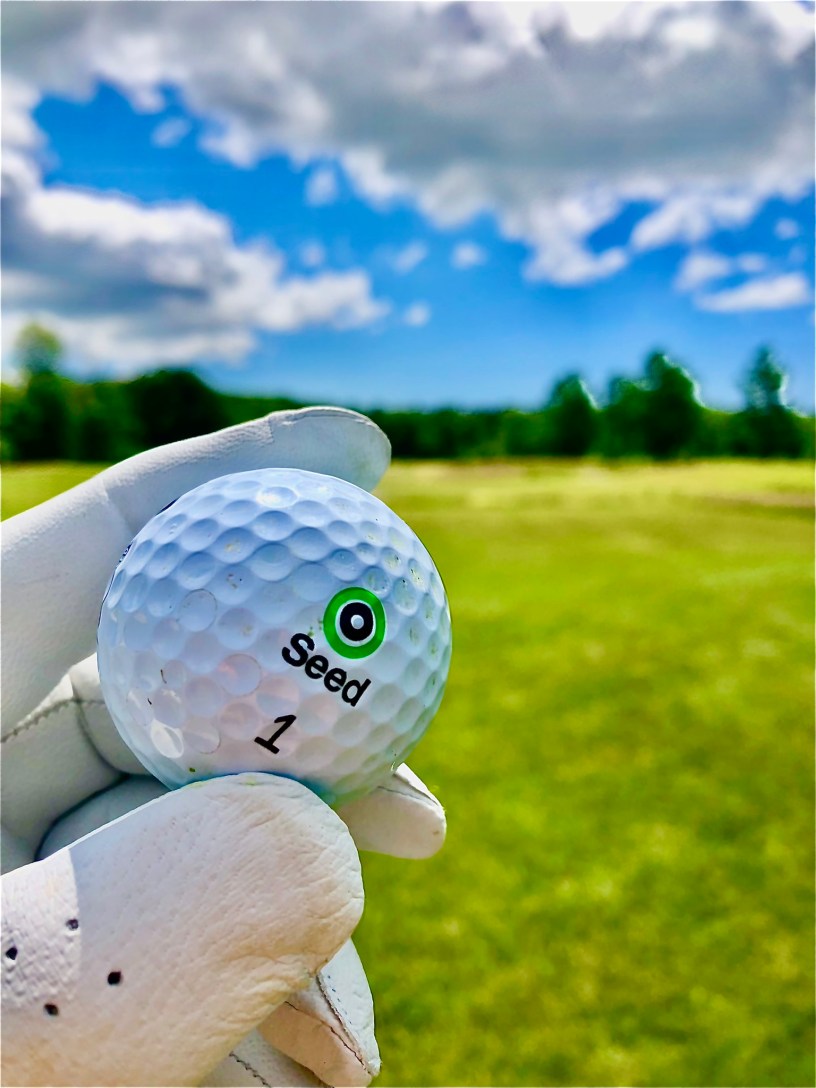
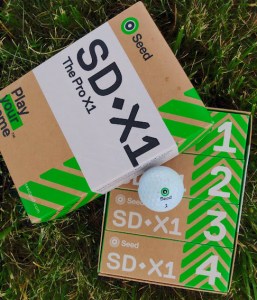
At the time of writing Seed Golf has five different models of golf ball ranging from it’s 2-piece DuPont Surlyn-covered SD-15 Country Mile ($20 USD/doz) to any of its “Premium” Urethane-covered offerings which won’t cost you more than $35 USD/doz including the 4-piece SD-02 The Pro Tour golf ball.. For the purposes of this testing and review I received the SD-X1 The Pro X1.
The SD-X1 The Pro X1 is a golf ball that could certainly appeal to a wide range of golfers. Admittedly, I felt drawn to the The Pro X1 and perhaps it was simply because of the
cheeky marketing in its name. I couldn’t help but feel that there were Pro V1 connotations attached to it. Perhaps, the moniker of this ball was strictly strategic and Seed Golf doesn’t try to hide the fact. They clearly call it “The Pro V1 Killer” on their website. The SD-X1 in that genre of golf ball that makes it a premium offering. Its 3-piece construction consists of high-speed, high-compression rubber core (EngCORE) that again is designed right there in Ireland at SETU. Lastly, there’s the cast urethane cover featuring a 332 dimple pattern.
The SD-X1 is designed for the golfer that is a low handicap golfer that might have a swing on the stronger side. Admittedly, this is something that I no longer classify myself as. So, let’s look at the SD-X1 as a golfer who is – for the moment – stuck with a swing speed of <100 mph.
When it comes to the SD-X1 off of the tee – with the driver – I noticed a couple of things right away. The Seed Golf SD-X1 does offer a flatter trajectory and when compared head-to-head to the “benchmark ball” the SD-X1 ended up being longer by about 5 yards. In fairways that could have been described as sloppy I didn’t notice any instances while using the driver where the SD-X1 landed behind the pitch mark. The SD-X1 always came to rest after the pitch mark indicating to me that it’s a lower spinning golf ball. Also, the control itself of the SD-X1 was very predictable.
Distances with irons and fairway woods were consistent like it was with the driver. A shade longer than the “benchmark ball” with the fairway woods and hybrids (they are low-launch/low-spin heads) but I thought that the distance with my irons dropped off to where the “benchmark ball” was. I attribute this to the lower, piercing trajectory that Seed Golf mentions.
When it comes to the feel of the SD-X1 this is a golf ball that is firm but not overly so, even with its higher compression. I could feel the golf ball compress off of the faces and for being “firm” it reminded me of a TaylorMade Golf TP5. As a matter of fact that was one of my remarks to my playing partner. I cannot say anything but good things about the feel of the SD-X1.
Spin. Much of the allure of using a premium, tour-caliber golf ball is about the spin performance that comes with it. The SD-X1 golf ball is a “drop and stop” golf ball through and through. Inside 100 yards the SD-X1 is a “spinning dynamo”. The SD-X1 spins, checks, and stops. Even out of rough where you’d expect a little more release. The very first SD-X1 that I struck in the short game segment of testing checked, slowed, and found the bottom of the cup.
The Finish
The cost of premium golf balls depends on where you live. In the United States a dozen Pro V1 will cost $60 USD. In Canada, the price of that same dozen is $72 CAD.
If you’re a golfer looking for high performance but don’t want to break the bank. Have a look at The SD-X1 from Seed Golf. In testing, the SD-X1 proved itself to be longer. From a feel standpoint I preferred it over a Pro V1. Overall, the spin was impossible to not notice. Green complexes that had “back stops” there was “back-up power”. The spin 50 yards and in is “stroke-saving” and predictable.
If there’s a flaw with the SD-X1 golf ball it might be the durability of the cast urethane cover. I did notice that it did blemish somewhat easily.
However, to get a ball of this quality at this price point how do you really complain? Again, you won’t pay more than $35 USD per dozen for any golf ball in the Seed Golf stable.
Until The Next Tee!!
Discover more from The Next Tee
Subscribe to get the latest posts sent to your email.
 The Next Tee